Scan-to-Twin: Converting an Outdated Asset Database into a Decision-Ready Digital Twin
March 12, 2026
Scan-to-Twin: Converting an Outdated Asset Database into a Decision-Ready Digital Twin

John Tauchus |
Reality capture + asset verification + data normalization for model-enabled operations
Co-authored by John Tauchus and Michael Brown, Production Modeling Corp (PMC).
Executive Summary
Facility teams rarely lack information—they lack information they can trust and operate with. In this project, a multi-building site had an enterprise asset database that no longer reflected field conditions. PMC partnered with the client’s FM stakeholders to define owner-aligned standards up front, then captured the site and interiors, verified asset existence with photo evidence, and delivered a normalized Asset Information Model ready for Revit-capable platforms such as Autodesk Tandem.
The Challenge: When the Asset List Isn’t Reality
Over time, facility changes outpace databases. Equipment gets replaced, relocated, renamed, or removed—while systems of record drift. When that happens:
- Work orders begin with verification (“Is it there? Where is it?”)
- Preventive maintenance becomes inconsistent
- Capital plans are based on incomplete inventories
- Teams fall back to spreadsheets and tribal knowledge
The client needed more than geometry. They needed a verified baseline that connects assets to real locations and consistent data standards.
The PMC Approach: Capture Reality + Verify Assets + Normalize Data
1) Reality Capture Across the Site and Interiors
PMC used drone capture for exterior/site context and laser scanning for interior conditions. The intent was to create a measurable “ground truth” that could be referenced remotely and used to reduce the need for repeat site walks.
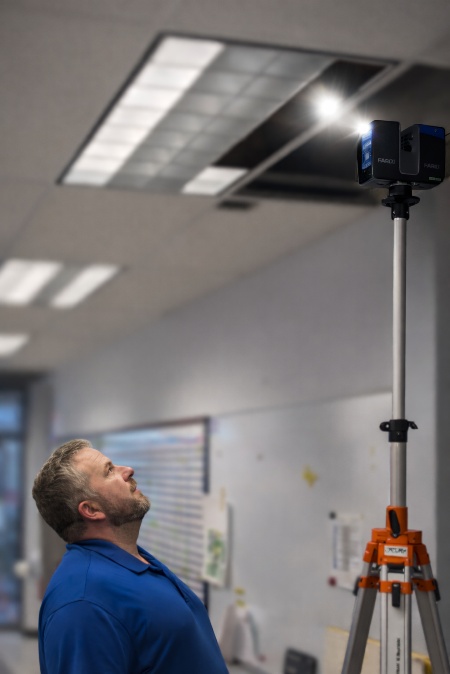
Figure 1 Field capture in progress. PMC collected interior reality capture using tripod-mounted laser scanning to establish an accurate baseline of existing conditions.
2) Scan-to-BIM Alignment for Spatial Confidence
Using the scan as the foundation, PMC aligned modeled geometry and systems to the point cloud, ensuring the model was anchored to as-is conditions.
3) Asset Existence Audit with Photo Evidence
In parallel, PMC performed a field audit to confirm each asset’s presence and capture supporting photos. Evidence was organized to enable stakeholders to validate assets quickly without repeated field trips.
4) Owner-Aligned Parameters for Enterprise Readiness
PMC implemented a client-aligned schema in Revit using (Owner) parameters so that asset records could be consistently structured for downstream use. The parameter set was then populated with verified values.
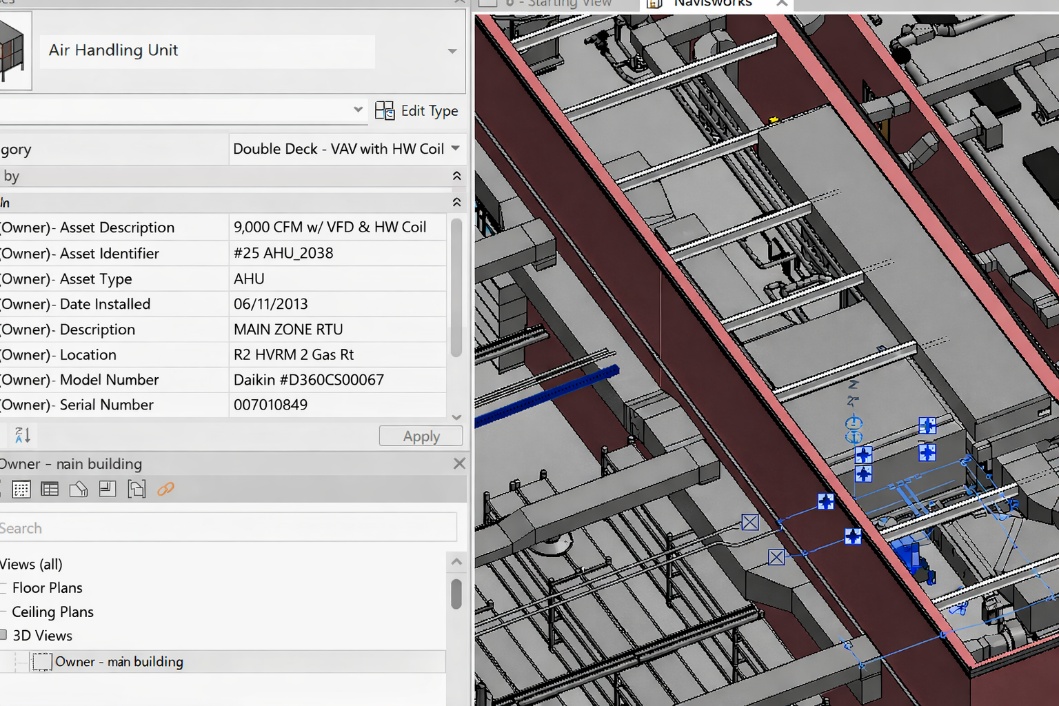
Figure 3 Owner-aligned asset data inside Revit. PMC implemented (Owner) parameters and populated verified values (identifier, type, install date, model/serial, etc.), supporting normalized handoff to enterprise systems.
5) Plan-Based Navigation and Fast Validation
To make the model usable for FM workflows, assets were made discoverable from familiar plan views. The process of tagging the assets is quite simple but can vary based on each site. Some clients will have full CAD drawings that can be used to pin each location of each asset, or in a situation where we are starting from scratch, overhead drone data can be used for ortho-mosaic photos of the building, where we can rough in the asset, then tighten it up once the scan data comes into play. Once the asset has been located, a geotagged pin is created in the plan view with all available information about the asset (photos, tag number, etc.).
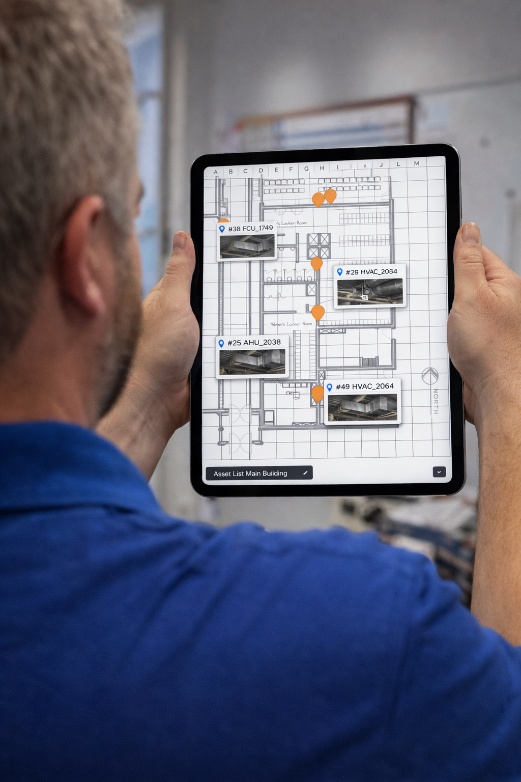
Figure 4 Plan-linked asset verification. Grey pins connect floor plan locations to specific asset records and photos (examples: #49 HVAC_2064, #38 FCU_1749, #25 AHU_2038), reducing time spent searching and validating in the field.
6) 3D Spatial Model Navigation
The same asset records and identifiers are accessible directly in the 3D view to support model-based planning, adjacency understanding, and future upgrade scoping.
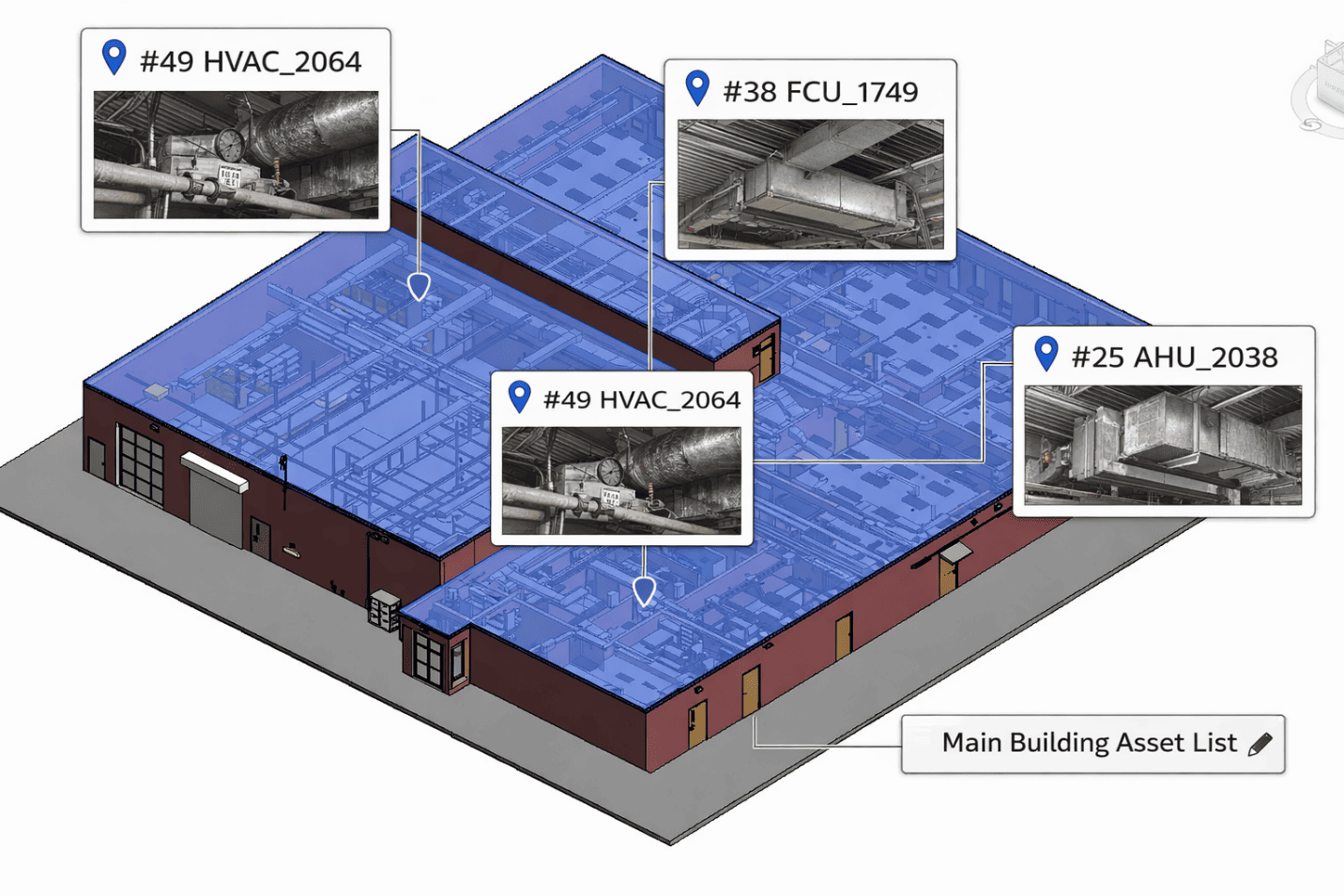
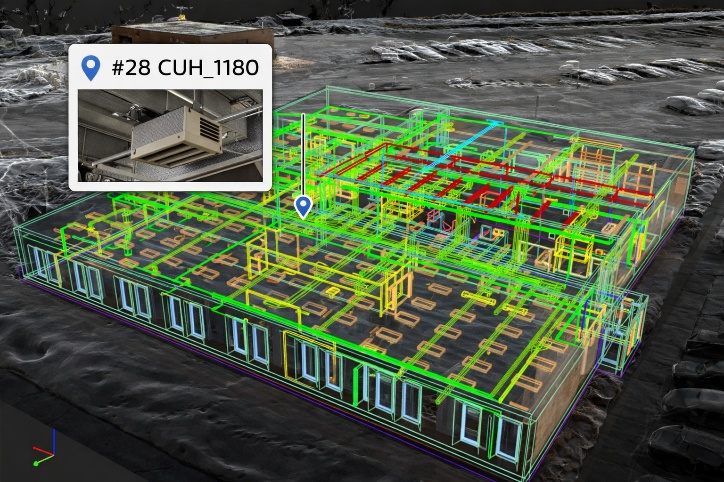
Figure 5 Asset callouts in the 3D model. Verified asset records are accessible directly in the spatial model, combining location, identifier, and photo evidence in one view.
Deliverable: A Normalized Asset Information Model
PMC delivered an Asset Information Model that:
- reflects verified as-is conditions (scan + audit)
- includes photo-backed asset evidence
- uses standardized, owner-aligned parameters
- is normalized for enterprise database integration
- is ready for Revit-capable model management systems such as Autodesk Tandem
Close: Improving Above-Ceiling Capture Quality
Above-ceiling conditions are often the hardest to document yet critical for reliable asset location and future planning. PMC’s scanning workflow emphasizes practical field efficiency and capture quality.
Conclusion: Scan-to-Twin succeeds when you partner with the right enterprise stakeholders
A Scan-to-Twin program is as much an enterprise alignment effort as it is a capture-and-model effort. The fastest way to create lasting value is to partner with the teams who will own the data after handoff—typically Facilities Management, Operations, and the enterprise system stewards responsible for CMMS/EAM and model-enabled platforms.
In many organizations, the opportunity begins within a scan-to-renovation lifecycle—where reality capture is commissioned to inform design and construction decisions. The outcome improves dramatically when FM stakeholders are brought in early to define what “record-ready” means: identifiers, location hierarchy, required attributes, naming standards, and acceptance criteria. That upgrade turns a project deliverable into an operational asset: a Record Information baseline that remains useful long after renovation is complete.
In this case, the client engaged PMC directly through the FM team, which enabled those decisions to be made up front. FM priorities—verified existence, photo evidence, plan-based navigation, and normalized parameters aligned to enterprise systems—guided the workflow from day one. The result wasn’t just a model; it was a trusted Asset Information Model that supports daily operations and can scale into platforms like Autodesk Tandem.
Ultimately, Scan-to-Twin works across any facility type or industry—but it lasts when it’s built with (and for) the people who will run the building tomorrow.
Let our experts show you how our Services can support your projects!
John Tauchus
As Director of Technology Integration at Production Modeling Corporation (PMC), I harness innovative technologies to drive operational expansion and develop new business opportunities. Specializing in Digital Twins for Facilities Owners and the AEC+O (Architectural, Engineering, Construction, and Operations) sector, I implement cutting-edge solutions that optimize performance, sustainability, and efficiency. With over 20 years of experience managing 3D-enabled BIM projects, I excel in workflow integration, strategic planning, and supply chain management. Additionally, I lead corporate initiatives in VDCO (Virtual Design, Construction, and Operations) technology deployment, empowering PMC staff across all market segments. My passion lies in fostering collaboration between people, processes, and technology, with a focus on VDC/BIM, Big Data, and virtual collaboration.
Linked inYou may also like
Scan-to-Twin for Warehouse Operations: Turning Storage Locations into Real-Time Digital Assets
John Tauchus | March 30, 2026

Comprehensive Steel Design & Detailing for a 10,000+ ft Automotive Conveyor System
Erica Smith | June 25, 2025

Capacity Study Using FlexSim and Layout Design for Consumer Goods Company
Erica Smith | June 10, 2025

Evaluation of Material Handling and Ergonomics in a University Hospital Network
Erica Smith | March 17, 2025