Scan-to-Twin for Warehouse Operations: Turning Storage Locations into Real-Time Digital Assets
April 3, 2026
Scan-to-Twin for Warehouse Operations: Turning Storage Locations into Real-Time Digital Assets

John Tauchus |
A joint perspective from PMC and TMC
By John Tauchus, PMC, and Todd Cahalan, TMC
Overview
This pilot began as a warehouse scanning effort intended to support updates to legacy 2D AutoCAD records. Through discovery with client stakeholders, the project revealed a much larger opportunity. In this environment, the most important assets were not machines or fixed equipment, but the storage spaces themselves: warehouse slots that could be available, occupied, constrained, or reassigned many times a day.
Delivered as a partnership between PMC and TMC, the effort brought together high-definition scanning, digital interpretation, data-structure planning, and a long-term update strategy. TMC performed the scanning, capturing the warehouse in the level of detail needed to ground the effort in real field conditions. PMC’s role was interpretation—aligning scan data with warehouse operations, developing custom Revit slot families, and building the data-rich 3D environment that turned storage locations into usable digital assets. Together, the teams helped shape both the supporting data structure and the maintenance scenarios required for long-term value.
What began as a documentation-focused effort evolved into a pilot demonstrating how a 3D workflow could redefine slot creation, geolocation, audit traceability, update planning, and future warehouse operations.
The Challenge
The client managed a large and constantly changing database of warehouse slot locations tied to aisle, rack, and storage logic. Slot conditions changed throughout the day as trucks were unloaded, parts were moved, and orders were shipped. When new rows of racks were added or layouts shifted, teams could spend months defining storage positions, assigning identifiers, and loading those records into operational systems.
Existing workflows depended heavily on simplified 2D methods and scripted AutoCAD processes. That legacy approach worked, but only within limits.
To keep input efficient, the 2D system had to stay generalized. The number of scenarios had to be controlled to allow the team to populate the database at scale. That efficiency came at a cost. Storage spaces were often defined more generically than field conditions permitted, even though the actual warehouse was shaped by local constraints, surrounding building elements, and unique slot conditions.
This created several problems:
- Defining new slot locations after layout changes took too long
- Documentation required repeated interpretation and manual validation
- Database logic was separated from physical conditions in the field
- Simplified slot assumptions increased the risk of operational inefficiency
- Future digital applications had no strong 3d foundation
The core issue was simple: the warehouse changed faster than the documentation method used to manage it.
Discovery Phase: The Turning Point
The initial goal was straightforward: scan the warehouse, audit conditions, and support updates to existing 2D records. During discovery, it became clear that 3D could do much more than help refresh drawings.
A modeled environment could instantly define geolocated slot positions in context. Instead of relying only on aisle-based script logic and drafting conventions, the storage locations themselves could become visible, structured, and data-aware in 3D.
That shifted the direction of the work. Rather than using scans solely to support 2D cleanup, the pilot began testing a more strategic idea: a warehouse twin in which slot volumes could be represented as digital assets tied to the same identification logic used in daily operations.
This reframed the effort from documentation to workflow transformation.
A Partnership Between PMC and TMC
A key part of this effort was the collaboration between PMC and TMC. The project required more than scanning and more than modeling. It needed a coordinated process that connected real field conditions, warehouse naming conventions, model structure, and long-term update logic.
TMC’s role focused on field capture, leading the high-definition scanning effort to document existing warehouse conditions and create the spatial foundation for the pilot. PMC’s role focused on interpretation—translating scan data into operational meaning through audit alignment, custom Revit slot families, and the development of a data-rich 3D model used to represent storage locations. Together, the teams also helped shape the data structure and the maintenance and update scenarios needed to support long-term operational use. That mattered because the long-term value of the warehouse twin depended not just on creating it, but on governing and maintaining it as layouts and slot conditions changed. Together, the teams demonstrated a stronger, more comprehensive digital warehouse strategy than a documentation-only approach could have delivered.
The Scan-to-Twin Approach
1) Scanning Existing Conditions
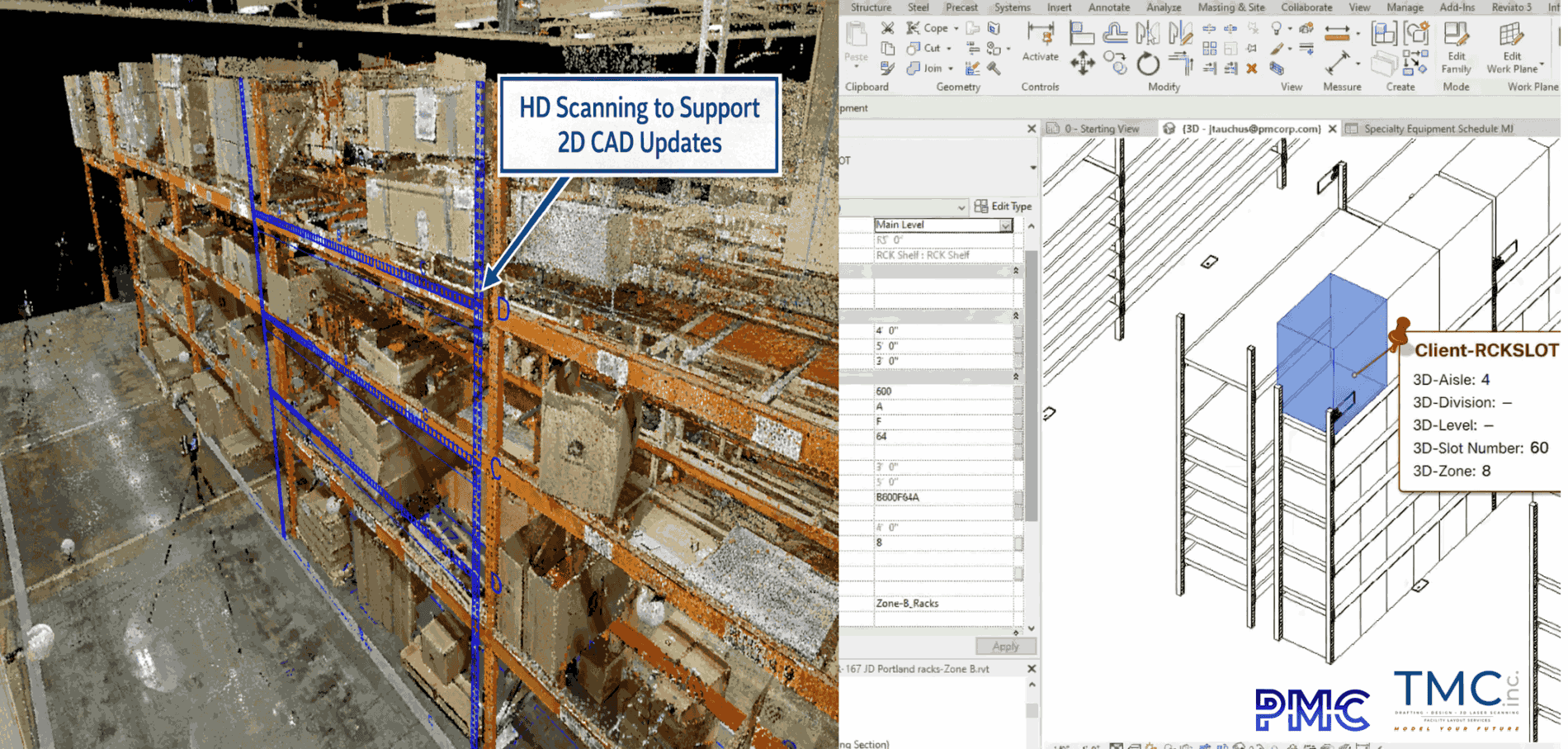
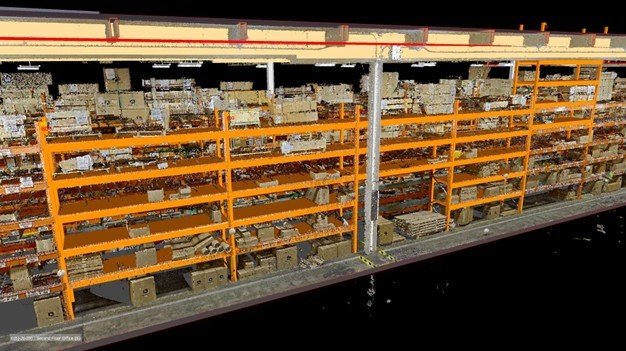
Site scanning captured the warehouse as it actually existed, including rack layouts, aisle conditions, and local physical constraints that could not be trusted from legacy CAD alone. One important advantage of the scanning workflow was that 360-degree images were created at each scan position. These images became an audit layer, allowing the team to reference real rack and slot identification labels already in use by warehouse staff.
2) Site Audit and Identification Protocol
While scanning, the team followed a bottom-up audit protocol using field identification tags. Rack and slot labels were documented consistently so they could tie back to warehouse data and eventually to Revit parameters carrying the exact same values.
This meant the process captured more than geometry. It captured operational identity.
That allowed modeled slots to align directly with the client’s warehouse naming standards and created a stronger bridge between field conditions, the database, and the model.
3) Auditing Against Reality
The audit phase confirmed where documentation had drifted from real conditions and where generic slot assumptions no longer matched the actual warehouse. This helped the team understand not just where racks existed, but how the storage logic functioned on the floor.
4)Modeling Storage Slots as Digital Assets
Custom Revit families were created to represent slot volumes as parametric objects. These were not just graphic placeholders. They carried parameters tied to aisle, division, level, section, slot number, zone, dimensions, and related warehouse logic.
A total of 167,900 slots were identified during the project. For each slot, 12 known data values were entered into custom Revit families using custom Python scripts generated with AI assistance. Additional parameters, including height and aisle proximity, were generated in Revit using modeled aisle spaces and elevation-based logic.
This gave the storage space itself a digital identity. Instead of drafting rack lines and separately scripting database values, the model could represent each slot as a visible, structured, data-bearing object.
5)Preparing for Interoperability
The long-term goal was interoperability between modeled slot objects and delivery and order workflows closer to real time. The pilot did not move fully into that end state, but it validated that a connected digital warehouse workflow was feasible with the right executive sponsorship and operational ownership.
Why 3D Outperformed 2D
One of the clearest findings from the pilot was that the 3D approach solved a major weakness in the legacy 2D workflow.
The 2D system had to stay generalized for efficiency. That kept input manageable, but it also meant the database sometimes defined spaces more broadly than field conditions actually allowed.
The scan-to-model workflow captured the nuance of the real warehouse. By modeling true geometry and accounting for surrounding conditions, the team could define many custom slot conditions more precisely than a simplified 2D method ever could. Through clash detection and detailed modeling of pipes, ducts, and other constraints, the team captured slot conditions that would have been missed in a more generic system.
This had direct operational value. A more accurate slot definition reduced the chance that a forklift operator would travel a long distance with material only to discover that the item did not actually fit into a location that appeared valid in a generalized system.
The benefit was not only better modeling. It was better decision-making at the point of use.
Operational Validation
Even though the effort remained at pilot stage, the project produced strong validation in several areas.
Full-Facility Slot Visibility
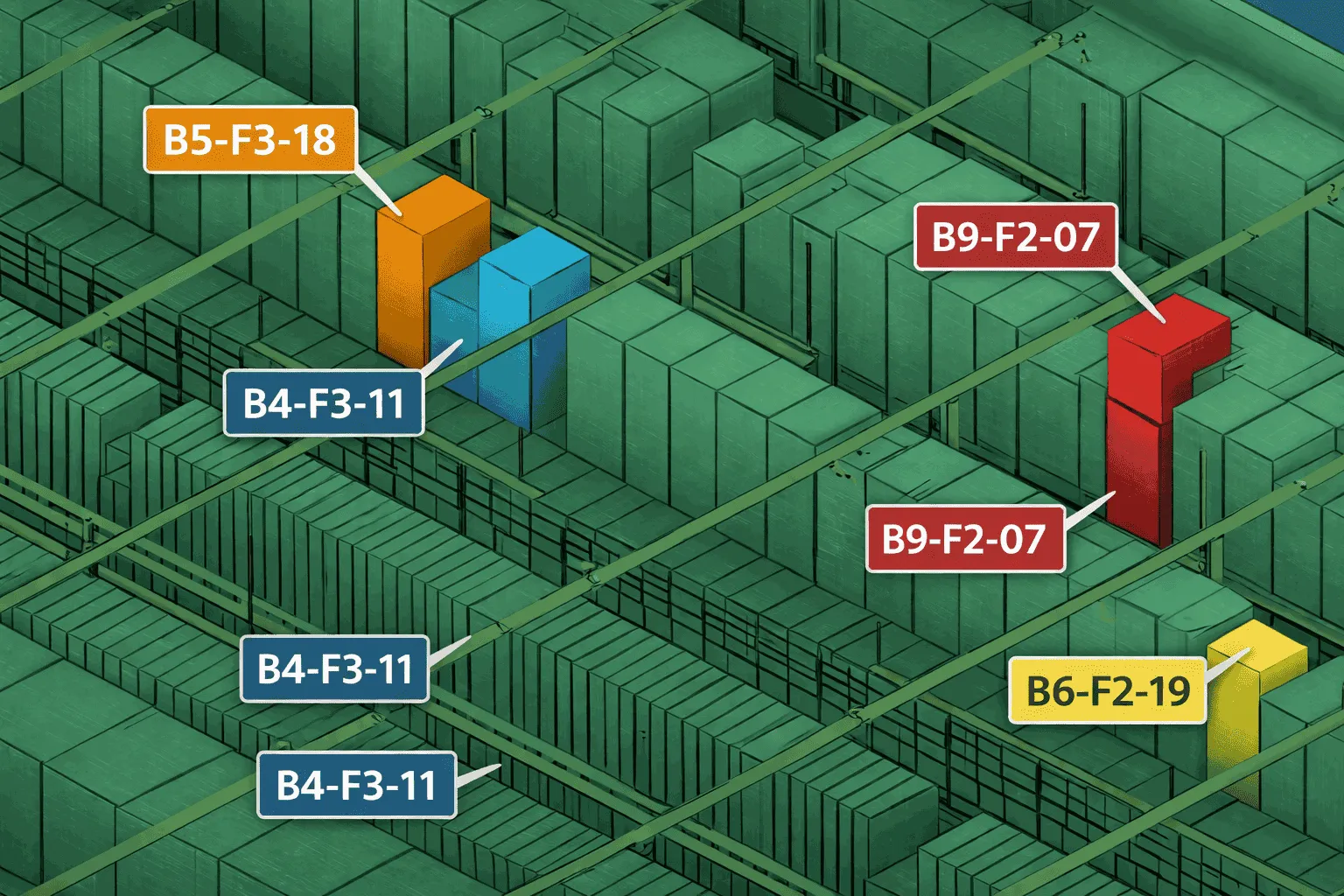
A color-coded 3D warehouse slot model demonstrated how the facility could be understood at scale. Storage locations across the warehouse could be visualized according to availability, weight class, and container compatibility.
This was a major shift from traditional documentation. Slot logic was no longer buried inside records and scripts. It became visible across the building in a way stakeholders could interpret immediately.
Faster Slot Definition
The model showed that new slot geolocation could be created much faster in 3D than through months of separate 2D drafting and script-based processing. Instead of reconstructing aisle logic manually, teams could define slot conditions directly in context.
Better Alignment Between Field and Data
Because the site audit process documented client labels and tied them to the model, the workflow created a more trustworthy relationship between what workers saw in the warehouse and what digital systems represented.
Improved Accuracy for Complex Conditions
Detailed modeling captured storage spaces affected by surrounding conditions and building constraints. This allowed the team to define custom slot conditions more reliably than the simplified 2D workflow.
Scalable Data Integration
The project also proved that warehouse slot modeling could scale far beyond a visual pilot. With 167,900 slots identified and 12 known values loaded for each slot, the team demonstrated that AI-assisted Python scripting could support high-volume population of Revit family data. Derived parameters such as height and aisle proximity showed that the model could also generate useful spatial intelligence, not just store imported values.
Future Application Scenarios
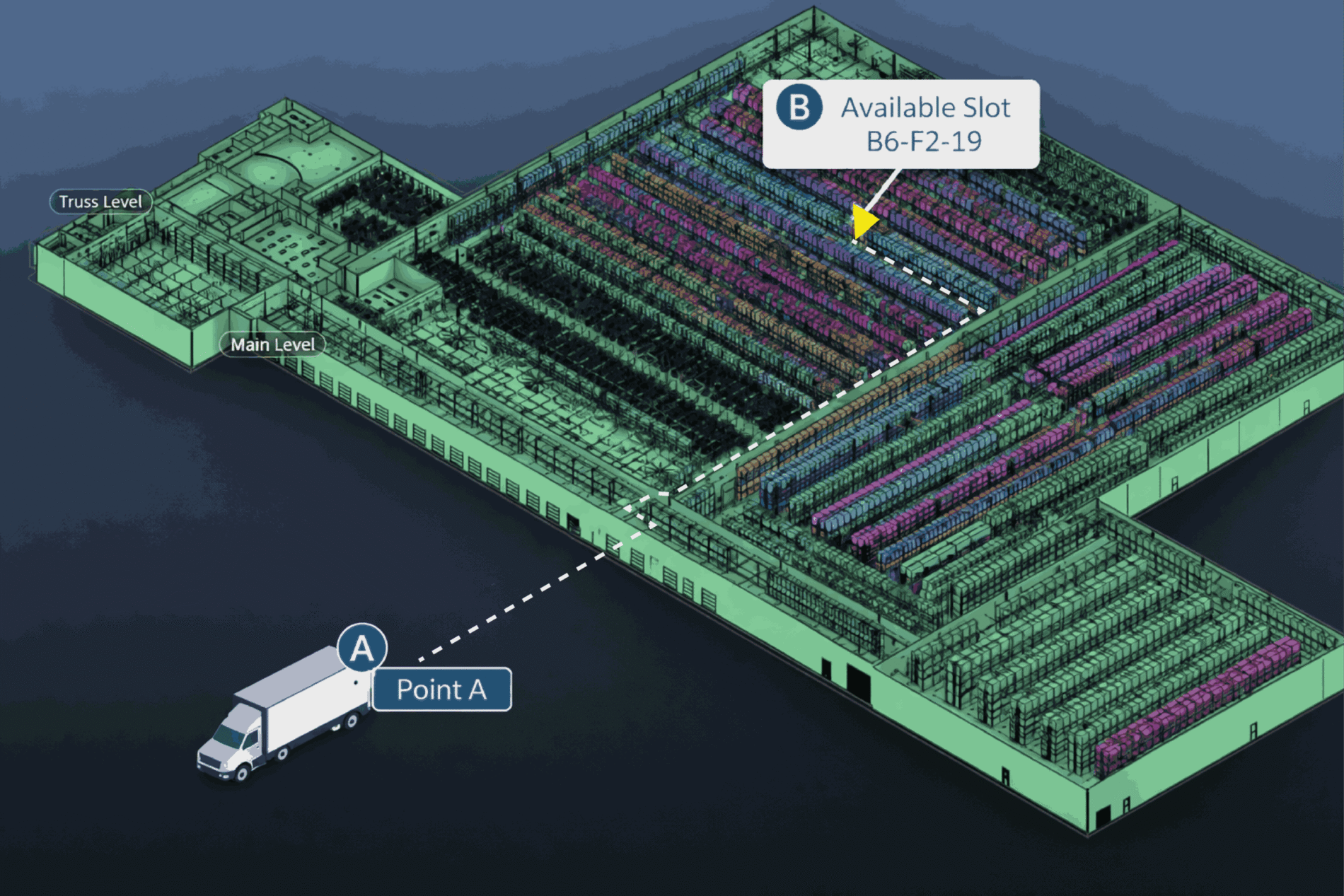
The pilot also opened the door to practical operational use cases beyond documentation.
One scenario discussed was a touchscreen kiosk at each plant entrance. This would allow any authorized user to select a slot and immediately see its contents. In a large and constantly changing warehouse, that kind of visibility could improve communication, reduce time spent tracking down storage locations, and make the warehouse easier to navigate for both experienced staff and visitors.
A second scenario focused on personnel running items through the warehouse. In that workflow, a worker could define a part or select a known part, and the system could highlight available locations that meet the storage criteria. The worker could then select a location and use wayfinding guidance to move directly to the correct space. This would reduce search time, improve placement accuracy, and help workers make faster decisions under real operating conditions.
These scenarios reinforced that the warehouse twin was not only a model. It was a foundation for future worker-facing tools.
What Prevented Full Deployment
The pilot did not progress beyond validation, but the remaining gap was organizational rather than technical.
A full implementation would require executive buy-in for a sustained 3D change-management process, ownership of model updates as layouts evolve, commitment to connected hardware and software workflows, and the enablement of warehouse workers to use the digital environment in their daily decisions.
The pilot proved the concept. Scaling it would require leadership support and a clear operating model.
Strategic Insight
This case study reinforces an important lesson in scan-to-twin strategy: sometimes the highest-value asset is not an object, but the space that object can occupy.
In this warehouse, the opportunity was not simply to document racks more accurately. It was to define the spaces created by those racks as managed operational assets. Once those spaces were modeled, parameterized, and tied to the same identification logic used in the field, the warehouse could begin to function as a digital operating environment rather than a set of periodically updated records.
ROI-Based Conclusion
The return on investment in this pilot should not be viewed only through the lens of model creation. The stronger ROI case comes from operational efficiency, reduced friction, and better use of labor over time.
In the legacy workflow, months could be spent defining new slot conditions after layout changes, while simplified 2D assumptions created downstream inefficiencies in daily operations. The scan-to-twin approach demonstrated a path to reduce that overhead by accelerating slot definition, improving confidence in space availability, and reducing failed placement events caused by generic slot assumptions.
The ROI case becomes even stronger when future applications are considered. A plant-entry touchscreen that lets users select a slot and see its contents can reduce search time, improve visibility, and lower dependence on tribal knowledge. A worker-facing tool that allows personnel to select a part, see qualified available locations, and follow wayfinding guidance to the correct slot can reduce wasted travel, shorten decision cycles, and improve consistency in material placement.
Taken together, those gains point to a broader business case:
- Less time spent redefining storage space after layout changes
- Less wasted travel and rehandling
- Fewer failed placement attempts
- Faster access to warehouse information
- Better labor efficiency in daily material movement
- Stronger readiness for connected operational applications
The pilot stopped short of production deployment, so the exact financial return was not measured. But the operational logic was validated: when warehouse space is treated as a digital asset and tied to real workflows, the value extends beyond documentation into measurable improvements in speed, accuracy, and labor efficiency. That is where the long-term ROI of a digital warehouse begins.
Closing Takeaway
This pilot showed that scan-to-twin can do far more than update warehouse drawings.
Through a joint effort between PMC and TMC, the team combined scanning, audit traceability, custom Revit slot families, AI-assisted Python scripting, data-structure planning, and maintenance scenario definition to demonstrate a credible path from legacy 2D slot definition to a digital warehouse workflow. The model made storage logic visible, improved accuracy, reduced dependence on generic assumptions, and created a foundation for future interoperability and worker-facing tools.
The effort stopped at pilot stage, but the validation was clear: when warehouse space itself is treated as a digital asset, scan-to-twin becomes a practical tool for operational change.
Let our experts show you how our Services can support your projects!
John Tauchus
As Director of Technology Integration at Production Modeling Corporation (PMC), I harness innovative technologies to drive operational expansion and develop new business opportunities. Specializing in Digital Twins for Facilities Owners and the AEC+O (Architectural, Engineering, Construction, and Operations) sector, I implement cutting-edge solutions that optimize performance, sustainability, and efficiency. With over 20 years of experience managing 3D-enabled BIM projects, I excel in workflow integration, strategic planning, and supply chain management. Additionally, I lead corporate initiatives in VDCO (Virtual Design, Construction, and Operations) technology deployment, empowering PMC staff across all market segments. My passion lies in fostering collaboration between people, processes, and technology, with a focus on VDC/BIM, Big Data, and virtual collaboration.
Linked inYou may also like
Scan-to-Twin: Converting an Outdated Asset Database into a Decision-Ready Digital Twin
John Tauchus | March 12, 2026

Comprehensive Steel Design & Detailing for a 10,000+ ft Automotive Conveyor System
Erica Smith | June 25, 2025
Capacity Study Using FlexSim and Layout Design for Consumer Goods Company
Erica Smith | June 10, 2025

Evaluation of Material Handling and Ergonomics in a University Hospital Network
Erica Smith | March 17, 2025